
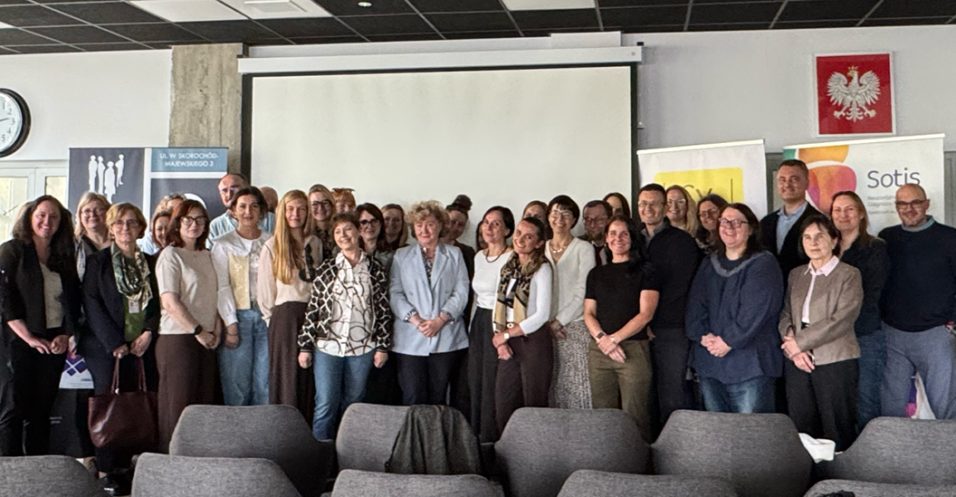
This spring, TRIAD – The Autism Institute at Vanderbilt Kennedy Center had the opportunity to come together with colleagues from Poland, along with a broader community of clinicians and diagnosticians, to discuss a critical issue shaping outcomes for children with suspected autism spectrum disorder: the quality and accessibility of early assessment.

Pablo Juárez, M.Ed., BCBA, LBA
“Even across very different healthcare systems, the challenges are strikingly similar: access, delays, and coordination of care,” said TRIAD co-director Pablo Juárez, M.Ed., BCBA, LBA. “We also know from the evidence that when children receive earlier, individualized support, it can meaningfully improve their developmental outcomes.”
TRIAD’s partner in this work is Centrum Terapii Autyzmu SOTIS – SOTIS for short – a Poland-based autism center providing comprehensive services across screening, diagnosis, therapy, and education for children and adolescents on the autism spectrum. Based in Warsaw, with additional sites across Poland, SOTIS integrates clinical care with research and training, emphasizing early identification and individualized, evidence-based interventions. Their programs span diagnostic evaluation, therapeutic services, parent support, and specialized preschool programs, with the goal of improving functional outcomes and supporting inclusion in mainstream education.
With many parallels to Vanderbilt TRIAD, the team was delighted to visit, learn more about SOTIS’ work firsthand, and explore opportunities to share resources and strengthen collaboration between the two centers.

Amy Swanson, M.A.
“It was especially meaningful to reconnect and build on relationships that began nearly a decade ago through early STAT training efforts in Poland,” said Amy Swanson, M.A., CCRP, who helped facilitate the original connection.
This collaboration was highlighted during an April symposium hosted by SOTIS and SYNAPSIS. TRIAD executive director Zachary E. Warren, Ph.D., shared a U.S. perspective on early autism screening, diagnosis, and current implementation challenges. TRIAD co-director Alacia Stainbrook, Ph.D., BCBA-D, expanded on approaches to building capacity through telehealth and system-level partnerships. In parallel, colleagues from SOTIS presented on the current autism diagnostic landscape in Poland, highlighting system-level challenges in access, coordination, and consistency of early assessment. SOTIS also shared their experience adapting and advancing evidence-based screening approaches, including TELE-ASD-PEDS, within the Polish care context.
The symposium brought together senior policymakers at the city and national levels, leading researchers and clinicians in autism and neurodevelopment, community psychiatry representatives from across Mazovia, directors of Warsaw’s Psychological-Pedagogical Counseling Centers, university academics, and journalists covering health and social policy. In total, 60 leaders attended onsite, with more than 1,200 participants registered to join remotely.
SOTIS highlighted key themes that emerged from the symposium as important for guiding future direction in Poland:
- Early identification requires coordinated systems, not just tools. Even the most effective screening instruments have limited impact if families face extended delays in accessing diagnostic evaluation and follow-up care.
- Telehealth represents a meaningful opportunity to expand access. Research on tools such as TELE-ASD-PEDS demonstrates that remote assessment, when implemented with rigor, can offer reliable and more accessible options for families, particularly those outside major medical centers.
Outside of the symposium, the VKC TRIAD team participated in on-site visits with SOTIS and partner organizations to better understand local clinical workflows, service delivery models, and early autism assessment practices in Poland. These exchanges provided valuable opportunities to observe care settings firsthand and identify shared strategies to strengthen screening, diagnosis, and service coordination across systems. Training on TELE-ASD-PEDS was also provided for SOTIS clinical staff.
“We are grateful to our partners at SOTIS for this meaningful exchange and shared commitment to improving early autism assessment,” said Alacia Stainbrook. “We look forward to future collaborations as we continue working together to advance more accessible and coordinated systems of care across our respective communities.”
Pictured top of page: TRIAD staff with colleagues from Poland.
