
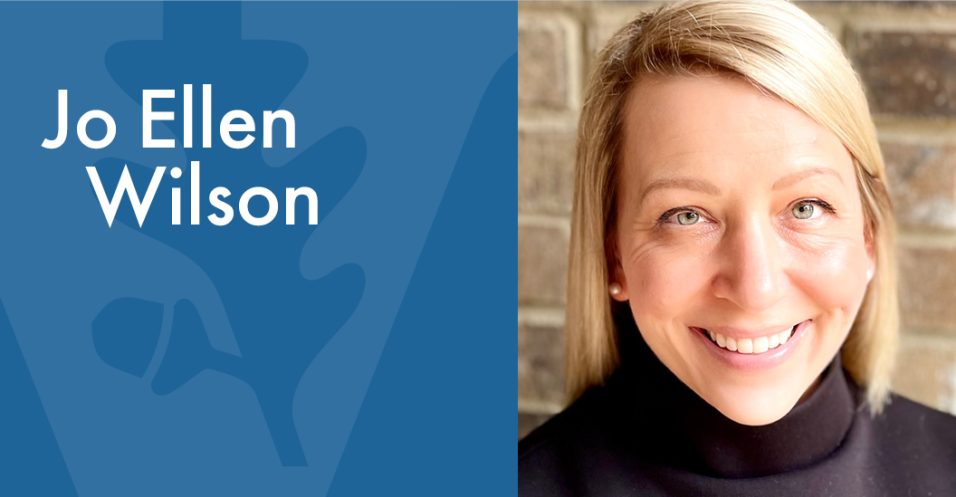
Vanderbilt Kennedy Center (VKC) member Jo Ellen Wilson, M.D., Ph.D., MPH, is an associate professor of Psychiatry and Behavioral Sciences and the director of the Division of General Psychiatry.
Wilson is a physician scientist with a research focus on Alzheimer’s disease in Down syndrome. She works with fellow VKC member Paul Newhouse, M.D., in the Center for Cognitive Medicine to run several studies in Down syndrome to characterize the cognitive, behavioral and neurobiological changes that occur as Alzheimer’s disease develops in the context of Down syndrome. She is the principal investigator for several therapeutic clinical trials for Alzheimer’s disease, including the ABATE trial (a vaccine to reduce/clear amyloid in the brains of individuals with Down syndrome).
In the interview below, Wilson shares how she became interested in disabilities research, describes her current research projects, and highlights how becoming a member of the VKC enhances the work she does.
Tell me about your attraction to developmental disabilities research. Do you have a personal connection to disability?
My attraction to developmental disabilities research is driven by both scientific curiosity and a strong commitment to equity in research participation. From a scientific perspective, I am deeply interested in understanding how Alzheimer’s disease develops in individuals with Down syndrome. The unique genetic and biologic features associated with Down syndrome provide an important opportunity to better understand the mechanisms underlying Alzheimer’s disease progression, behavior change, cognitive decline, and neurodegeneration. I find this area of research especially compelling because it has the potential not only to improve care for individuals with Down syndrome, but also to advance our broader understanding of Alzheimer’s disease biology.
Equally important to me is the principle that individuals with Down syndrome and other developmental disabilities deserve meaningful inclusion in research. Historically, many individuals with developmental disabilities have been underrepresented or excluded from clinical research and therapeutic trials, despite often carrying a disproportionate burden of disease. I believe strongly that research should be inclusive, ethically grounded, and designed to ensure that all populations have access to the potential benefits of scientific advancement.
Aside from the research I conduct, I run a psychiatric clinic devoted to caring for the behavioral and cognitive needs of adults with Down syndrome. While I do not have a direct personal connection to disability, my experiences working with individuals with Down syndrome and their families have reinforced the importance of conducting research that is both scientifically rigorous and patient-centered.
What are your current research interests and what problem(s) or challenge(s) do they address?
My current research interests focus on Alzheimer’s disease in individuals with Down syndrome, particularly through the development and implementation of therapeutic clinical trials aimed at preventing or slowing cognitive decline. Individuals with Down syndrome are at extraordinarily high risk for developing Alzheimer’s disease due to the triplication of chromosome 21, which includes the amyloid precursor protein gene. As life expectancy for individuals with Down syndrome has increased substantially over the past several decades, Alzheimer’s disease has emerged as one of the most important health challenges facing this population and is the leading cause of death in adults with Down syndrome over the age of 35.
My work addresses several interconnected challenges. First, individuals with Down syndrome have historically been underrepresented in Alzheimer’s disease research and have often been excluded from therapeutic clinical trials. This has created major gaps in knowledge regarding the safety, efficacy, and tolerability of emerging Alzheimer’s therapies in this population. A central goal of my research is to ensure that individuals with Down syndrome have equitable access to research participation and the potential benefits of scientific advances, while also ensuring that these potential therapies are safe and well-tolerated in this population.
Second, there remains a critical need to better understand the clinical presentation, biomarkers, and progression of Alzheimer’s disease in Down syndrome. My research seeks to improve early identification of cognitive decline and refine methods for measuring treatment response in clinical trials. This includes integrating cognitive assessments, neuropsychiatric measures, imaging, and biologic biomarkers to better characterize disease trajectories and therapeutic outcomes.
Finally, my work is motivated by the broader goal of improving quality of life for individuals with Down syndrome and their families. Alzheimer’s disease in this population creates substantial emotional, medical, and caregiving challenges, and there is an urgent need for evidence-based interventions. By leading therapeutic clinical trials and advancing inclusive research practices, I hope to contribute to the development of treatments that are both scientifically effective and accessible to this historically underserved population.
Do you have a story about a research participant or a breakthrough that illustrates the impact of your work?
Yes, have you seen the recent Vanderbilt Medicine article or Channel 4 or Channel 5 stories about one of our research participants, Evan Dewey, who is participating in the ABATE trial? He is the first AD clinical trial participant with DS in the entire Southeast.
What are your reasons for becoming a VKC Member? How does the VKC enhance the work you do?
I am interested in becoming a Vanderbilt Kennedy Center Member because the Center provides a strong collaborative environment for researchers focused on developmental disabilities across the lifespan. My work in Alzheimer’s disease in individuals with Down syndrome would benefit greatly from the VKC’s interdisciplinary network and its emphasis on translating research into meaningful improvements in care and quality of life.
The VKC would enhance my work by creating opportunities for collaboration with investigators across neuroscience, psychiatry, aging, and developmental disabilities research. It would also strengthen opportunities for mentorship, trainee involvement, and community engagement related to clinical research in Down syndrome. Most importantly, the VKC’s mission aligns closely with my commitment to advancing inclusive research and improving outcomes for individuals with developmental disabilities and their families.
