
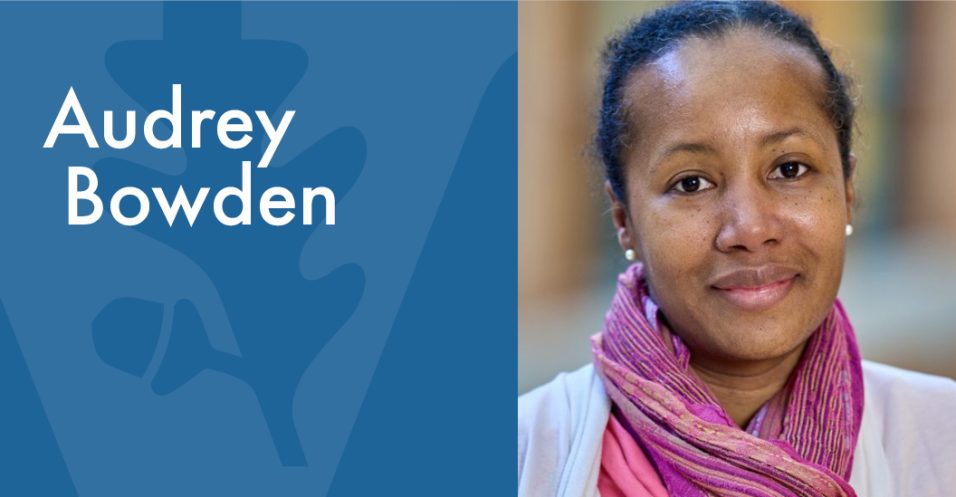
Vanderbilt Kennedy Center (VKC) member Audrey Bowden, Ph.D., is a professor of Biomedical Engineering and Electrical and Computer Engineering. Bowden’s lab develops light-based technologies such as optical coherence tomography and functional near-infrared spectroscopy to assess health, detect disease, and monitor treatment. Some of her current projects are targeted towards development of neuromonitoring and neuroimaging technologies to assess brain activities for different conditions. A primary clinical motivation for this work has been evaluation of attention-deficit/hyperactivity disorder (ADHD) in children.
In the interview below, Bowden shares how she became interested in disabilities research, describes her current research projects, and highlights how becoming a member of the VKC enhances the work she does.
Tell me about your attraction to developmental disabilities research. Do you have a personal connection to disability?
As an engineer, much of my career has been spent developing tools to solve other people’s problems. That is, I have not necessarily been limited to working on any particular clinical problem or demographic. The general theme that describes my research interests is that I develop light-based tools to assess health, detect disease, and monitor treatment.
My first encounter with research related to developmental disabilities arose when a collaborator approached me and asked for help building a device to address challenges in diagnosis and clinical intervention for ADHD. At the time, I did not realize that I would later come to understand that I had personal connections to ADHD through members of my family and my husband’s family.
Those personal connections naturally make the research even more meaningful and give me a strong drive to help address the problem. I think it is always important to remember that we are not doing this work simply because it is our job or our hobby. We are doing it because there are people on the other side of our technologies who can truly be helped and served by them.
Personally, the difference I want to make in the world is to help improve other people’s lives. I am excited about the research I am doing, and I am especially excited about these new directions in my work that serve individuals with developmental disabilities. This work is allowing me to learn more about my field and to build new connections with people I hope to serve.
What are your current research interests and what problem(s) or challenge(s) does it address?
As I mentioned earlier, I have ongoing research in the area of ADHD, although the work in my lab spans many other clinical needs, including cancer, infertility, neonatology, and more. I am also particularly drawn to developing technologies that can be used outside of the traditional lab environment. For example, in our ADHD research, we are developing technologies that would allow families to monitor brain activity in their children at home rather than in a lab or MRI setting.
The research topic that most recently connected me with the VKC grew out of a conversation with Laurie Cutting, a longtime and much-beloved VKC member, and her ongoing work with individuals with reading disabilities. This topic is very meaningful to me because, as a young girl, I remember the many times my father told the story of how, as a child, he did not learn to read until he was older. He was stigmatized, and the school system was not helping him. It was really the intervention of his mother, who stepped in and helped him learn to read, that made the difference and set my family in a new direction. My father went on to be the first in his family to attend college; I was the first to attend graduate school and earn my Ph.D.
I have always viewed my father as a very successful person, and I know that his early educational experiences shaped his expectations for me and my brother to excel academically — something I have passed on to my own children as well. I have also seen firsthand the challenges faced by adults with reading disabilities through experiences in my husband’s family: someone very close to him never learned to read. For these reasons, the idea that our current VKC project could help identify ways to improve reading interventions for people with reading disabilities is deeply meaningful to me.
Do you have a story about a research participant or a breakthrough that illustrates the impact of your work?
My work in the area of developmental disabilities is just getting started, so unfortunately I do not yet have a strong story to share about the impact of that work. However, I am very excited to embark on this new direction, and I truly hope that the work I do will make a meaningful impact — both for individuals I may meet personally and for many others I may never have the chance to meet.
What are your reasons for becoming a VKC Member? How does the VKC enhance the work you do?
I left another institution to come to Vanderbilt about eight years ago, and one of the most important factors in my decision was the opportunity to find a community of kind, like-minded researchers in the areas of my research interest — people I could connect with personally and with whom my students could also connect. I am so happy to be able to join the VKC.
Even though I am a new member, the resources provided through the VKC already feel incredibly valuable, and I only wish I had realized earlier how much the Center had to offer. I have already appreciated participating in seminars hosted through the VKC. I have also benefited from seed funding to support my work in this new research direction, and I enjoyed attending the Science Day research symposium, where I was able to learn about the wonderful work being done across the VKC.
It has been both inspiring and reassuring to see that there are so many deeply committed researchers on our campus who love what they do, who care deeply about people, and whose work is truly making a positive difference in the world. I would be honored to be counted among them.
Photo by Harrison McClary / Vanderbilt
