
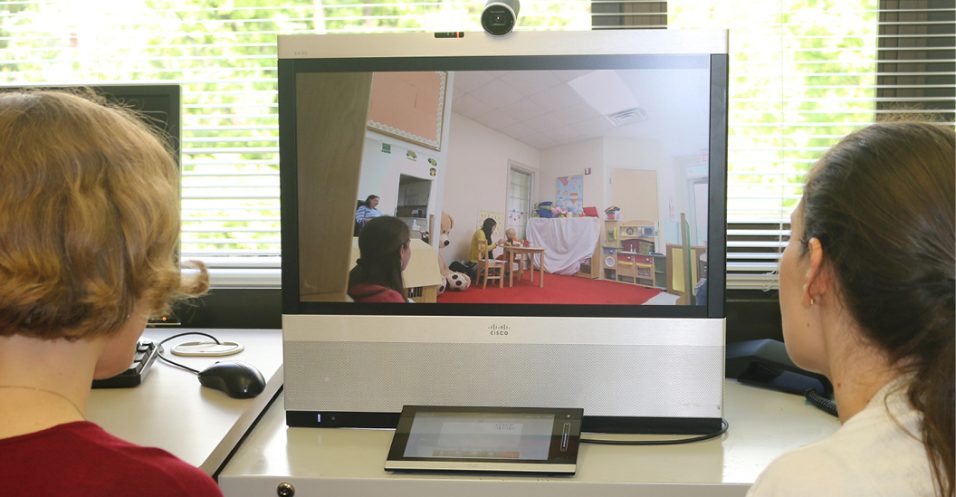
TRIAD, the autism institute at the Vanderbilt Kennedy Center, pioneered using telehealth to assess for autism in young children nearly a decade ago, and now the team has received a new grant from the National Institute of Mental Health (NIMH) to evaluate a similar telehealth assessment tool for preschool-age children between 3 to 6 years of age.

Laura Corona, Ph.D.
“This project is truly a team effort,” said Laura Corona, Ph.D., assistant professor of Pediatrics at Vanderbilt University Medical Center, director of TRIAD Psychology Postdoctoral Training, and principal investigator for the new grant. “It builds on more than a decade of work by the VKC TRIAD team to develop tools for assessing autism in young children via telehealth and to study how those tools can be used accurately, in ways that are meaningful to families.”
TRIAD’s early tele-assessment work focused on toddlers and received NIMH funding as well as support by the Tennessee Early Intervention System (TEIS). Around 2018, the TRIAD team developed and began to evaluate a tool called the TELE-ASD-PEDS (TAP), which was designed to assess autism-related behaviors in toddlers. That research has shown that tele-assessment is an accurate way to identify autism in young children. The TAP is now used regularly for tele-assessments in Tennessee and beyond.
This project, titled Rigorous evaluation of the TAP-Preschool: Toward effective, efficient models of autism tele-assessment, will evaluate the use of the TELE-ASD-PEDS-Preschool, or TAP-P. The TAP-P is a tele-assessment tool designed to evaluate children between 3 and 6 years of age for autism. During the TAP-P, a clinician interacts with a child and a parent or caregiver via telehealth. The clinician coaches the parent and child through a set of play and social activities that allow the clinician to observe the child’s social interactions, communication, and play. There are two different versions of the TAP-P – one with activities for children who are speaking in sentences to communicate, and one with activities for children who do not use words to communicate or use only single words or short phrases. After observing the activities, the clinician provides ratings for several different child behaviors that can be related to autism. The clinician uses those ratings, together with other information from the parent and child, to determine whether a diagnosis of autism is appropriate for that child.
This study has two main purposes:
- The first is to test the use of the TAP-P in a large sample of children to determine (1) the accuracy of the TAP-P in comparison to an in-person autism evaluation and (2) the psychometric properties of the TAP-P, meaning how different scores on the TAP-P are related to the likelihood that autism is an accurate diagnosis for a child.
- The second purpose is to develop a tool that can help clinicians predict which children and families will benefit more from tele-assessment – meaning those children most likely to receive an accurate, confident diagnostic decision via tele-assessment.
“We know from our past research that clinicians can accurately and confidently make a decision about autism via tele-assessment for children who are using less verbal language – those who do not use spoken words to communicate or those who are using only one or two words at a time,” Corona said. “Our past research has also told us that tele-assessment is more complicated for preschool-aged children who are speaking in longer phrases or sentences. For some of these children, clinicians are less confident about making a diagnostic decision over tele-assessment and often recommend in-person evaluation. This research will try to develop a way to know, in advance, which of these more verbal children will be appropriate for tele-assessment and which may be best served with an in-person evaluation.”
This study intends to recruit 350 children between 36 and 72 months of age over the five-year study period. All children will first complete a tele-assessment using the TAP-P with one of the TRIAD study clinicians. All children will then complete an in-person evaluation at Vanderbilt Health UMC, with a different clinician.
TRIAD’s tele-assessment efforts were started by Zachary Warren, Ph.D., executive director of TRIAD and director of the Division of Developmental Medicine at Vanderbilt Health, and Amy Weitlauf, Ph.D., associate professor of Pediatrics at Vanderbilt Health and TRIAD associate director of Research, together with TRIAD’s co-directors Alacia Stainbrook, Ph.D., BCBA-D, and Pablo Juárez, M.Ed., BCBA, LBA.
“The research leading up to this point would not have been possible without our amazing research staff, led by Amy Swanson, M.A., CCRP, nor without the participation of many wonderful children and their families,” Corona said.
This research team will include Corona, Warren, and Weitlauf, as well as Alexa Dixon, Ph.D., assistant professor of Pediatrics at Vanderbilt Health and TRIAD associate director of Early Intervention Outcomes, and Chris Slaughter, Ph.D., associate professor of Biostatistics at VUMC.
“We know that families often experience significant barriers when they try to access autism evaluations for their children,” Corona said. “There are often long waitlists for autism evaluation for the preschool-age group, meaning that families are waiting and worrying about their child’s development, sometimes for years. Even when an appointment is available, families often have to travel long distances to unfamiliar places. We have seen that tele-assessment can reduce these barriers for families of toddlers.
“My hope is that this research with the TAP-P can extend these successes to preschool-aged children and their families, in our state and beyond,” she added.
For more information on this project, contact Corona at laura.l.corona@vumc.org.
