
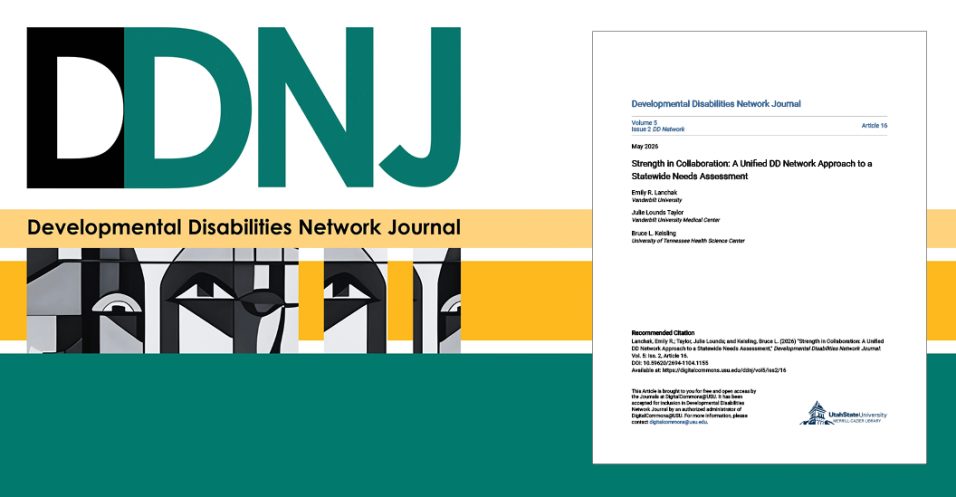
A new publication, “A Unified DD Network Approach to a Statewide Needs Assessment,” is now available in the Developmental Disabilities Network Journal. The publication describes how Tennessee’s Developmental Disabilities (DD) Network came together to conduct a first-of-its-kind statewide needs assessment designed to better understand the experiences, priorities, and support needs of people with disabilities and their families across the state.
Typically, state Councils on Developmental Disabilities, Protection and Advocacy agencies, and University Centers for Excellence in Developmental Disabilities each conduct their own assessments. Tennessee’s DD Network is made up of the Tennessee Council on Developmental Disabilities, Disability Rights Tennessee, the University of Tennessee Center on Developmental Disabilities, and the Vanderbilt Kennedy Center UCEDD. Tennessee’s collaborative approach offers a more efficient and comprehensive alternative.

Emily Lanchak, Ph.D.
“One of our goals in conducting a joint needs assessment was to demonstrate how collaboration across DD Network partners can strengthen the quality, reach, and impact of needs assessment activities that are required for strategic planning,” said Emily Lanchak, Ph.D., the project coordinator and lead author on the publication. “By aligning resources, reducing duplication and survey fatigue, and creating a shared dataset to guide our decision-making, we are strengthening our Network and are better positioned to meet the needs of Tennesseans with disabilities and their families.”
The two-year, mixed-methods effort allowed partners to gather input from nearly 1,500 participants using an accessible statewide survey and follow-up focus groups. The process emphasized accessibility at every stage, including multiple survey formats, language options, and accommodations such as screen-reader compatibility and American Sign Language interpretation. Equally important, individuals with lived experience were involved throughout the design and implementation process, ensuring the data collected was meaningful, relevant, and respectful of diverse perspectives.
While the publication describes the outcomes of the collaboration, it also outlines the process that made it possible.
“A key first step is establishing a shared vision across partners,” said Lanchak. “In Tennessee, this meant aligning early on common goals, such as reducing survey burden, centering community voice, and identifying opportunities for coordinated systems change. Regular cross-network meetings and strong leadership engagement helped maintain alignment and ensured that each of our organization’s unique requirements were incorporated into the effort.”
Another critical element was the co-development of the assessment tools. Rather than combining separate surveys, Tennessee’s partners worked collaboratively to design a single instrument that addressed multiple priorities while remaining accessible and easy to use. This required a process of drafting, reviewing, and refining survey content, along with pilot testing with stakeholders. By involving community members and leveraging expertise within the network, the partners were able to create a comprehensive yet streamlined tool that minimized duplication and maximized participation.
Coordinated outreach and resource sharing also played a central role in the project’s success. By pooling their networks and communication strategies, partners were able to reach a broader and more diverse audience across the state, including individuals in rural communities and those who are often underrepresented in data collection efforts.
Importantly, the Tennessee model emphasizes the value of using shared data to drive collective action. By analyzing results collaboratively, DD Network partners can identify common priorities, align their strategic plans, and pursue joint advocacy and programmatic initiatives.
“Ultimately, we wanted to underscore a simple but important message with this work,” said Lanchak. “When organizations work together and listen to the people they serve, they can build a stronger foundation for advancing missions and improving quality of life for individuals with developmental disabilities.”
Overall, the paper provides practical guidance for states seeking to strengthen their DD Network partnerships. By demonstrating that a unified approach is not only feasible but also highly effective, Tennessee offers a replicable model that can help other states reduce burden, elevate community voices, and create a more coordinated and responsive system of supports.
Paper citation:
Lanchak, Emily R.; Taylor, Julie Lounds; and Keisling, Bruce L. (2026) “Strength in Collaboration: A Unified DD Network Approach to a Statewide Needs Assessment,” Developmental Disabilities Network Journal: Vol. 5: Iss. 2, Article 16.
To read the full Tennessee DD Network Statewide Needs Assessment Report, visit Community Needs Assessment.
Headshot photo by Darren Shipley, Transition Tennessee.
