
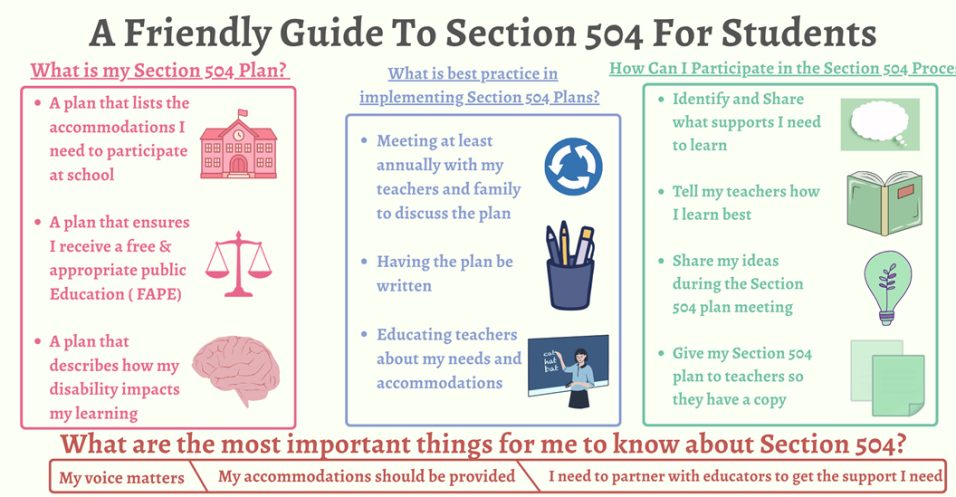
Many people are aware that students with disabilities are able to access an education under the Individuals with Disabilities Education Act and having an Individualized Education Program (IEP), but there is much less awareness and research about the access for students with disabilities under Section 504 of the Rehabilitation Act of 1973.
Meghan Burke, Ph.D., BCBA-D, professor of Special Education, has been working for the past several years, with researchers who include siblings of people with intellectual and developmental disabilities (IDD) and people with lived experience, to understand the experiences of families and youth trying to receive accommodations with what are called Section 504 plans. The project is a collaboration with the Council of Parent Attorneys and Advocates (COPAA). They have interviewed more than 150 parents and youths and conducted a national survey with more than 200 parents and youth. Last fall, they piloted an education program to help families understand their rights under Section 504. They plan to test the program again in the fall of 2026 in a randomized controlled trial. She and her team have created a series of infographics in English and Spanish that highlight some of the frequent barriers to accessing supports under Section 504; more importantly, the infographics also identify strategies for youth with disabilities and families to better understand the Section 504 process.

Meghan M. Burke, Ph.D., BCBA-D
“One message that we continually find is that parent and youth knowledge about Section 504, their advocacy, and empowerment matter,” Burke said. “It is critical for families and youth to be informed about their rights to services and to feel empowered to assert their rights.”
To be eligible for a Section 504 plan, a student must have a physical or mental impairment that substantially limits one or more major life activities. A Section 504 plan allows for accommodations, such as extra time on tests or preferred seating, whereas an IEP offers specialized instruction. Currently about 1.6 million students are served under Section 504.
Some of the issues Burke and her team found were:
- Conflicts regarding a student’s eligibility
- A lack of transparency about the process of getting a Section 504 plan
- Families feeling ignored by school staff
- Inadequate accommodations
- Failures to implement the plans
- Educators often lack knowledge about Section 504 plans
Burke hopes that the research, which can be found in links below, and this series of infographics will help educate parents, students with disabilities, and educators at all levels about Section 504 of the Rehabilitation Act and its important role in helping many students with disabilities successfully engage in school.
The infographics can also be found on the project’s social media via Instagram. Research participants who indicated that they wanted to know the research findings have received this information.
“We have been fortunate to have had an incredibly rich sample for our interviews and surveys—youth and families are interested in sharing their experiences with Section 504,” Burke said. “To that end, it is critical that we disseminate our findings not only with academic and the research community but also directly back to youth, families and educators in accessible formats. Thus, we created the infographics so our results can directly impact the disability community. “
Burke’s project is funded by the National Institute on Disability, Independent Living, and Rehabilitation Research (NIDILRR) grant number 90DPGE0101.
Here are the recent research reports on families’ experiences with getting Section 504 plan:
- Frequently Asked Questions and Answers for Supporting Students With Section 504 Plans
- Exploring Family Experiences With Section 504 Plans for Their Autistic Children
- The Experiences of Youth With Disabilities in Accessing Supports Under Section 504 of The Rehabilitation Act of 1973
- Exploring the Experiences of Twice-Exceptional Youth With Section 504 Plans in School
- Exploring Parents’ Experiences With Dispute Resolution Under Section 504 of the Rehabilitation Act of 1973 in Schools
- Identifying the Correlates of Maternal Stress Among Mothers of Children with Section 504 Plans

