
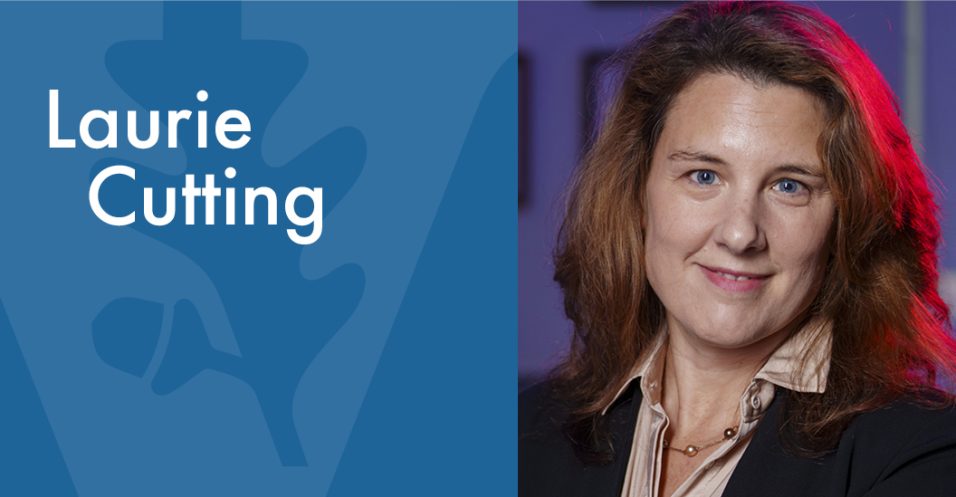
Vanderbilt Kennedy Center (VKC) member Laurie Cutting, Ph.D., is Patricia and Rodes Hart Professor of Special Education, professor of Psychology, Radiology, and Pediatrics, and associate director of the Vanderbilt Kennedy Center (VKC). As faculty director of the Reading Clinic for nearly two decades, Cutting has bridged the gap between her laboratory discoveries and direct service to individuals with reading disabilities throughout the Nashville metropolitan area, embodying the VKC’s philosophy of connecting research with real-world application. Her role as VKC associate director and director of the VKC’s Translational Neuroimaging Core allows her to advance the VKC’s mission of improving the lives of people with intellectual and developmental disabilities and their families through research, service, training, dissemination, and educational advocacy.
In the interview below, Cutting shares how she became interested in disabilities research, describes her current research projects, and highlights how becoming a member of the VKC enhances the work she does.
Tell me about your attraction to developmental disabilities research. Do you have a personal connection to disability?
I always knew that I wanted to work with children somehow, but early on, I wasn’t sure what my path would be. It was during a year that I took off from college where my interests really crystalized. I was fortunate to work in an elementary school as a teacher’s assistant for their first-grade classrooms. There, I observed some children whose reading skills developed with ease, and others who really struggled. I got fascinated with why this was happening — what was happening in their brains that made one child develop into a highly skilled reader, whereas for another, the patterns of letters remained a mystery? From there things just sort of took off; I got my doctorate, all the while being really curious about how education and the brain intersected. At the time, the field educational neuroscience — an interdisciplinary field that bridges cognitive science, neurobiology, and education — didn’t really exist. Fortunately, I landed in places that were open-minded and had mentors that saw that these two fields needed to be connected. I was fortunate enough to be part of the development of this field, since its early conceptualizations, at this point over 25 years ago. Now it is a flourishing and recognized area of neuroscience.
What are your current research interests and what problem(s) or challenge(s) do they address?
My research focuses on understanding the neural mechanisms underlying learning and development, specifically, the neurobiological and behavioral aspects of developmental and genetic disorders related to reading, language, and cognitive functions, with the ultimate goal of informing early identification and the development of interventions.
My current ongoing research encompasses multiple complementary approaches. I apply large-scale longitudinal, interventional, cross-sectional, meta-analytical, and genetic approaches to improve understanding of both normative developmental neurocognitive processes and developmental disorders, including learning disabilities, language disorders, neurofibromatosis, and others. One major theme of my work explores factors that contribute to cognitive development and academic success or failure in early and middle childhood, especially in children with learning difficulties. My commitment to making children’s lives better is my guiding principle, with the hope of eventually advancing fundamental neuroscience enough so that it translates to fostering real-world clinical benefit.
Do you have a story about a research participant or a breakthrough that illustrates the impact of your work?
For me, there are so many different stops along the way that have been semi-breakthroughs, but I have yet to have the breakthrough that I ultimately want, which is to understand how to identify and intervene early so that children don’t encounter difficulties as they start school that not only make learning a struggle, but also then often leads to a hit on their self-esteem. But I would say that two of our recent papers, one in Developmental Cognitive Neuroscience, and another in Nature, are steps that are encouraging. The Developmental Cognitive Neuroscience paper connects brain activity with learning from texts that children are reading while they are in an MRI scanner. This is a step forward towards understanding what is happening moment by moment as children are trying to integrate old with new knowledge during reading comprehension. The Nature paper with colleagues is a major step forward towards allowing us to use neuroimaging metrics at the individual level in developmental disabilities – not just the group level. Being able to use individual neuroimaging metrics would open so many doors for early identification and intervention. For example, what if you knew early on if white matter patterns deviated from what they should be in areas that we know are associated with reading abilities. You could think about early intervention to address difficulties children might encounter, such as those with dyslexia, well before they struggle with reading. It also may allow us to eventually tailor interventions to specific neurobiological profiles.
What are your reasons for becoming a VKC Member? How does the VKC enhance the work you do?
The Center’s integrated focus — spanning neuroscience, education, early intervention, health, and quality of life — directly aligns with my commitment to translating neuroscience research into meaningful clinical and educational outcomes. The VKC’s status as both an Intellectual and Developmental Disabilities Research Center (IDDRC) within the national network of 14 IDDRCs, and a University Center for Excellence in Developmental Disabilities Education, Research, and Service (UCEDD) provides an ideal nexus to facilitate my work and more broadly to contribute meaningfully to advancing diagnosis, prevention, treatment, and amelioration of intellectual and developmental disabilities. More specifically, my VKC affiliation significantly enhances my work by providing access to specialized research infrastructure and core services. Further, the VKC connects me to collaborators across disciplines, strengthening the interdisciplinary nature of my investigations. This framework has enabled me to deeply invest in mentorship and training—a core passion of mine.
