
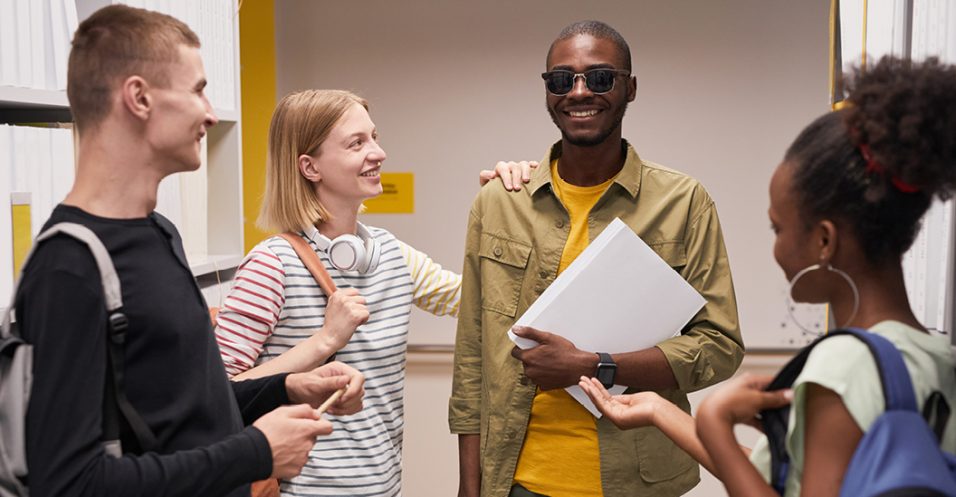
Students who are deafblind vary widely in their abilities, their level of disability, and their support needs, and they often present unique challenges in how teachers can best tailor supports and modifications to enhance the students’ success at school.

Rachel Schles, Ph.D.
A team led by Rachel Schles, Ph.D., an assistant professor of the practice in Special Education and a Vanderbilt Kennedy Center member, wrote an article entitled “Improving Access for Students Who Are Deaf-Blind Through Collaboration.” The manuscript encourages classroom teachers and related service providers to work closely with other teachers and professionals with expertise in deafness/hard of hearing and low vision/blindness education. The authors also emphasize the importance of using individual student data to improve access to the curriculum and promote social interactions for that particular student. Families, too, will find helpful information about who might be included in their child’s school team and what their roles might be.
Most students with deafblindness have some functional hearing and vision. They may use spoken language, sign languages, or their own signs or gestures. Some use with an augmentative and alternative communication device. Some may use tactile communication, including a system called haptics. Haptics is a standardized system for providing and/or receiving visual and environmental information as well as social feedback via touch signals on the body. (See video examples here.) Deafblind students may require high-contrast or large visuals. Many of these students have also other disabilities, including cognitive disabilities or complex health care needs, which require additional accommodations or modifications.
While there are some teachers with specific training in deafblindness, they are a rarity. Professionals who may be very useful as part of a student’s Individualized Education Program team include teachers of students with the visual impairments, educational interpreters, orientation and mobility specialists, and teachers of students who are deaf/hard of hearing. Each one conducts unique assessments that provide data to inform recommendations for accommodations and modifications to address the varied needs of a particular student.
Of course, finding time to bring all these professionals together to brainstorm and collaborate can be difficult during the school day. The article’s writers, which include Jasmine Low, a teacher of students with visual impairments and recent graduate of the Vanderbilt Visual Disabilities Track; Allison Conway, certified teacher of the visually impaired and certified orientation and mobility specialist for the Tennessee School for the Blind in Nashville; and Danielle Petersen, educational interpreter of Knoxville, TN, suggest seizing any opportunity for in-person conversations, but also encourage determining the means of communicating that all team members find personally effective. These methods can include email, voice memos, or shared digital files.
Accurately assessing deafblind students can be difficult, and the paper encourages educators to only use testing procedures that appropriately meet the needs of the individual student. Teachers may need to observe and listen to an individual student and collect input from others who interact with the student to get a complete picture of how the student might best be tested.
The goal, of course, is postsecondary success and the greatest degree of independence each student can achieve. For deafblind students, enhancing their abilities to communicate, to interact successfully with their peers, and to be able to travel across their campus and their community are all vital to that success. This team approach can help students achieve that goal.
“I am thrilled to get to share our work with educators and families,” Schles said. “On a personal note, when I was starting out as a teacher of students with visual impairments, I felt unprepared to fully support deafblind students on my caseload. I wasn’t alone in that feeling, and I was lucky enough to get to collaborate with three amazing professionals (an educational interpreter, a teacher of the deaf, and a certified orientation and mobility specialist). We pooled our knowledge, collaborated closely, and saw significant improvement in our shared student’s engagement and abilities. We also all grew quite a lot professionally just by talking and working together. My personal experiences, as well as the individual experiences of all the authors of this paper, caused this to be a real passion project, which we hope others will learn from.”
To learn more, the paper, published in “Teaching Exceptional Children,” can be freely downloaded here.
Top photo by Getty Images/iStockphoto
