
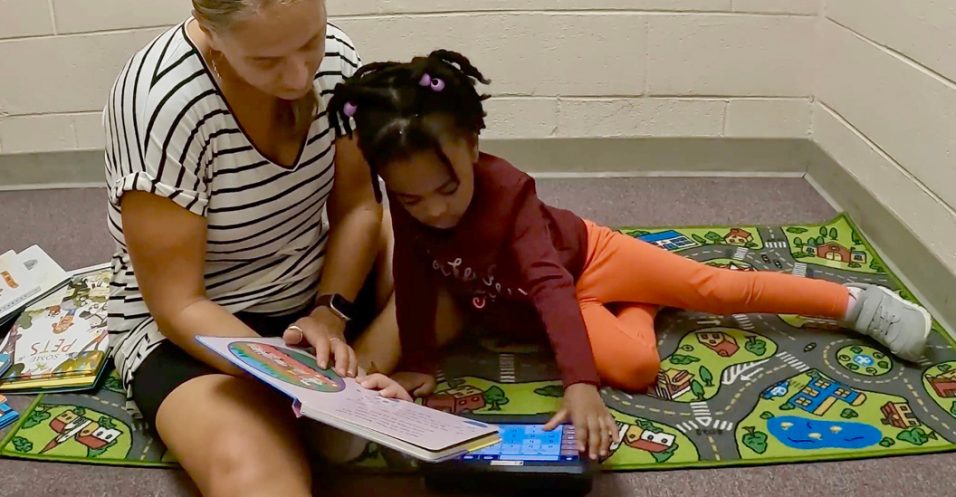
A new five-year project led by Elizabeth Biggs, Ph.D., assistant professor of special education and a Vanderbilt Kennedy Center member, is taking on a long-standing gap in early education for children with disabilities who are nonspeaking or have very limited speech.
The project, called PATHS to Reading, focuses on helping students in pre-kindergarten through second grade build strong reading and language skills using augmentative and alternative communication (AAC). AAC includes tools such as picture-based systems and speech-generating devices that allow children to communicate when spoken language is difficult or not possible. PATHS stand for Promoting Augmentative and Alternative Communication Based Teaching for High-Impact Early Reading Skills.
Elizabeth Biggs, Ph.D.
“Reading is a foundational life skill, yet many children with intellectual and developmental disabilities have historically been left out of comprehensive reading instruction,” said Biggs. “Instead of being taught how to decode words and understand language, these students have often been offered limited instruction focused on memorizing a small number of sight words. Research over the past few decades has shown that this approach sells students short. With the right support, children who use AAC can learn core reading skills and achieve far more than was once assumed possible.”
The PATHS to Reading project aims to close the gap between what research shows is possible and what actually happens in classrooms. The project will help schools and districts learn how to integrate AAC into high-quality reading instruction. The work emphasizes teaching language and literacy in everyday environments, supporting shared reading experiences, directly teaching early reading skills like letter sounds and phonological awareness, and strengthening partnerships between families and schools.
A major part of the project involves creating free, accessible online training for educators, therapists, administrators, and families. These video-based modules will be developed in partnership with the team at TRIAD, the autism institute at the Vanderbilt Kennedy Center, and will show how AAC can be used during reading instruction. The modules will include practical tools such as planning guides and reflection activities.
“We’re very excited to partner on the project with TRIAD,” said Biggs. “Their expertise, alongside an advisory board that includes parents, educators, and researchers, will ensure the materials are high quality and grounded in real-world experience.
After the training materials are developed, the team will pilot them in schools, working closely with educators, students, and families to see what works well and what needs improvement. In later years, the project will expand to school districts across the country, gathering information about how PATHS to Reading can be implemented and sustained in different settings. By the final year, the focus will be on sharing these resources widely so that more schools can adopt effective AAC-supported reading instruction.
Ultimately, PATHS to Reading is about access and opportunity. By giving children who rely on AAC the tools and instruction they need to learn to read, the project aims to open doors to greater independence, education, and participation in community life. As AAC advocate Bob Williams has said, “Reading is fundamental”—and this project is working to make sure that message truly applies to every child.
Top photo courtesy Elizabeth Biggs.
