
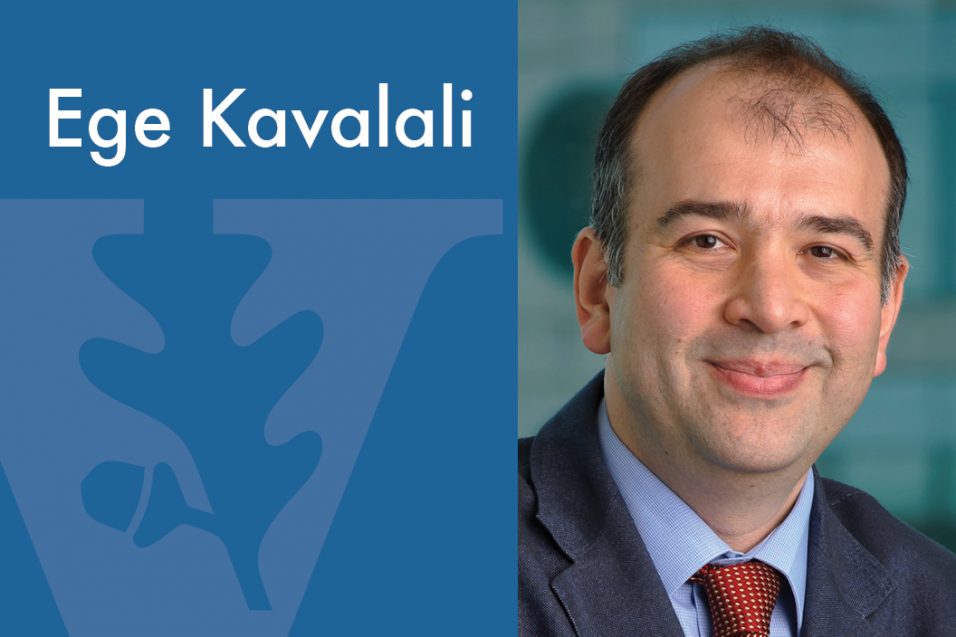
Vanderbilt Kennedy Center (VKC) member Ege Kavalali, Ph.D., is the William Stokes Chair In Experimental Therapeutics and serves as professor and acting chair of the VUMC Department of Pharmacology. His research interests are focused on learning more about the fundamental function and structure relationships of central synapses of the brain in health and disease. A synapse is a junction between two nerve cells, across which impulses pass to one another.
Kavalali recently completed and published a study on idiopathic epilepsies, which is a group of epileptic disorders characterized by recurrent and unprovoked seizures. Patients with idiopathic epilepsy often exhibit symptoms in infancy or early childhood, leading to neurodevelopmental delay disorders with epilepsy. These patients often have a comorbidity (or additional diagnosis) of intellectual disability, autism spectrum disorders, depression, anxiety, and attention-deficit/hyperactivity disorder (ADHD).
In the interview below, Kavalali shares what inspires his research in developmental disabilities, what he’s learned through his lab’s work, and how membership with the Vanderbilt Kennedy Center helps him achieve his goals.
Tell me about your attraction to developmental disabilities research. Do you have a personal connection to disability?
While I do not have a personal connection to disability, throughout my career I had the privilege to meet several patients with disabilities and their families. It is always reassuring to know that the fundamental research we conduct on neuronal communication is relevant to the pathology and treatment of several neurodevelopmental disorders.
What are your current research interests and what problem(s) or challenge(s) does it address?
We are interested in understanding the mechanisms that underlie function and stability of synaptic connections in the nervous system. Synapses are smaller than a micron (size of a bacteria) structures that functionally connect neurons to each other and to other target organs (such as muscle and glands). They are essential for information processing and storage in the nervous system. They are exquisite nano-machines, and their malfunction or degeneration leads to neurological, neuropsychiatric, and neurodevelopmental disorders.
Do you have a story about a research participant or a breakthrough that illustrates the impact of your work?
In a recently published work (Alten et al., Neuron 2021), we addressed several open questions on de novo mutations in an essential protein that regulate neurotransmitter secretion from synapses and give rise to diverse clinical manifestations seen in developmental and epileptic encephalopathies of infancy and childhood. These are debilitating disorders with complex symptoms that do not typically respond to classical anti-epileptics. For me, a great personal aspect of this work was the fact our interest in these mutations were triggered by a patient, whose mother specifically encouraged us to work on this question.
What are your reasons for becoming a Vanderbilt Kennedy Center (VKC) Member? How does the VKC enhance the work you do?
I am honored to be part of a highly accomplished community of scholars who are interested in neurodevelopmental disorder mechanisms and their treatment. We all need critical feedback and insight from our colleagues. No one can operate in a vacuum. The VKC possesses top-caliber clinicians, scientists, and the dynamic environment, which will undoubtedly provide new perspectives for our studies.
Photo courtesy UTSW/BrianCoats
